When Drogba Stopped A War: The 2006 AFCON And Côte d’Ivoire’s Call For Peace
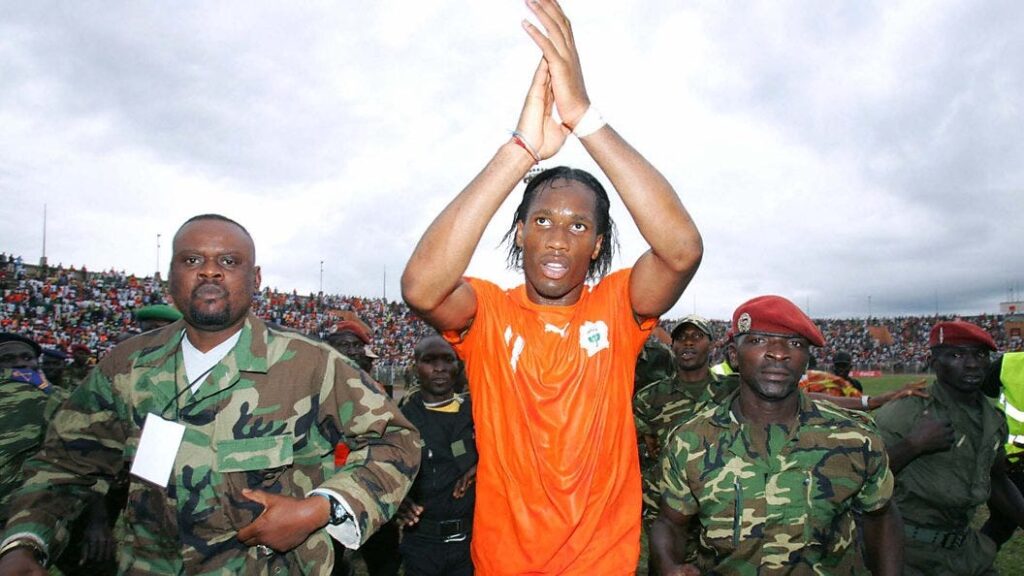
In October 2005, Côte d’Ivoire was divided by civil war.
The fighting between the north and south had torn the country apart for three years, leaving thousands displaced and communities fractured.
But amid the uncertainty, one unexpected voice rose above politics, that of footballer Didier Drogba.
The national team captain used a World Cup qualification celebration to deliver a message that would resonate far beyond the pitch.
A Divided Nation
The Ivorian civil war began in 2002, splitting the country between rebels in the north and government forces in the south. Once considered one of West Africa’s most stable economies, Côte d’Ivoire was now a nation in crisis.
Roads were blocked, communication between regions was limited, and distrust had become part of everyday life.
Yet football remained a shared passion. The national team, the Elephants, featured players from all parts of the country, north and south, Christian and Muslim.
The Message That Stopped the War
After Côte d’Ivoire beat Sudan 3–1 to qualify for the 2006 FIFA World Cup which was their first ever, Drogba and his teammates made an emotional appeal on national television.
Surrounded by players in the dressing room, the then Chelsea striker asked his fellow Ivorians to stop fighting.
He said: “Men and women of Côte d’Ivoire, we proved today that all Ivorians can coexist and play together with a shared goal. Please, put down your weapons and hold elections.”
The message quickly spread across the country. It was spontaneous and delivered at a time when the public needed a symbol of hope.
Fighters on both sides reportedly paused hostilities, and political leaders acknowledged the influence of Drogba’s call.
It did not end the war overnight, but it created a rare moment of unity and pushed both parties back to dialogue.
Football Becomes a Platform for Peace
Drogba’s words had an impact because they came from a figure who transcended politics.
He was respected not only for his success in Europe but also for how he represented Ivorians abroad.
When the Africa Cup of Nations (AFCON) began in Egypt in 2006, the Elephants carried the hope of reconciliation.
Côte d’Ivoire reached the final before losing to hosts Egypt on penalties, but their performance inspired optimism back home.
The team’s unity on the field mirrored the peace many Ivorians longed for. Football became a rallying point for citizens who had lost faith in politics.
Bouaké: A Match Beyond Football
A year later, Drogba proposed that the national team play a home match in Bouaké which was the main city in the rebel-held north.
It was a bold idea that required government and rebel cooperation. When it finally happened, the national flag flew across a once-divided zone, and people from both sides of the conflict watched together in peace.
The Elephants won that match 5–0, but the real victory was emotional. Bouaké, once a city of tension, had become a stage for unity.
A Legacy of Influence
Drogba continued using his platform for humanitarian work through the Didier Drogba Foundation, focusing on health, education, and social development.
His role during the conflict earned him recognition from the United Nations and respect far beyond football.
Though Côte d’Ivoire’s political challenges continued after the war officially ended in 2011, the events of 2005–2007 remain an important reminder of football’s potential to influence peace.
Drogba’s appeal is still remembered as one of the most powerful intersections between sport and politics in African history.