
‘Disgraceful’ and ‘poor image’ – the disorder that overshadowed Senegal’s victory
Senegal Crowned Africa Cup of Nations Champions Amid Controversy
Senegal triumphed over Morocco to capture the Africa Cup of Nations title for the second time, but the match ended in turmoil after they momentarily refused to continue when the hosts were awarded a controversial penalty during stoppage time while the score remained 0-0.
Referee Jean Jacques Ndala called for a penalty in the 98th minute after consulting the Video Assistant Referee (VAR) to review a tackle by defender El Hadji Malick Diouf on Brahim Diaz.
In a dramatic turn of events, head coach Pape Thiaw, frustrated after a previous Senegal goal was disallowed, led his team off the pitch in protest.
Though some players followed Thiaw’s lead, former Liverpool star Sadio Mane encouraged his teammates to return to the field.
After a delay of 17 minutes, the players ultimately returned to continue the match.
Diaz, the tournament’s top scorer, was entrusted with the penalty kick, but his lackluster ‘Panenka’ attempt was easily saved by Senegal goalkeeper Edouard Mendy. Shortly after, the referee signaled the end of the match.
In the fourth minute of extra time, Villarreal midfielder Pape Gueye netted the decisive goal, securing Senegal’s second victory in five years.
Post-match, Morocco’s coach Walid Regragui criticized Senegal’s actions as “shameful,” arguing they do not reflect well on Africa.
FIFA President Gianni Infantino condemned the “ugly scenes” in a social media statement.
Thiaw Admits to Missteps in Press Conference
Thiaw’s post-match press briefing was cut short due to a disturbance in the media area. However, in a subsequent interview, he acknowledged that his decision to take the players off the field was a mistake.
“We didn’t agree,” he mentioned. “I don’t wish to dwell on the incidents. I apologize for any disruptions to football.”
He continued, “In hindsight, I brought them back onto the pitch. Reactions can be emotional during intense moments. We recognize the referee’s errors.”
Thiaw expressed outrage over Ndala’s disallowance of a goal from Crystal Palace’s Ismaila Sarr, who scored from close range only for his effort to be ruled out due to a foul by Abdoulaye Seck on Achraf Hakimi during the preceding play.
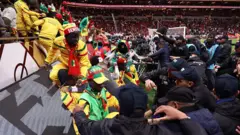
As frustration built over the penalty decision, several Senegal players complied with Thiaw’s request to exit, while some fans attempted to storm the field.
A dejected Diaz, who was substituted after Gueye’s goal, lamented Morocco’s missed opportunity to secure their first AFCON title since 1976.
Post-match, Mane emphasized the importance of maintaining a positive image in football: “I felt it would be absurd to not finish the game just because of a penalty call. I’d rather lose than let our football suffer in this manner.”
He added, “Football shouldn’t pause for ten minutes. Nonetheless, we accept our actions, and it’s a relief that we returned to play and what was meant to happen, happened.”
Goalkeeper Mendy, now with Al-Ahli in Saudi Arabia, expressed pride in how Senegal, under Mane’s leadership, managed to regroup and achieve their second AFCON title this decade.
“We shared a message amongst ourselves,” Mendy stated. “We did this collectively, and that’s what’s pivotal. We can be proud.”
Match-winner Gueye shared, “We felt injusticed. Moments before the penalty was called, we had what we believed to be a goal that was overlooked by the referee.”
“Sadio [Mane] urged us to return, and we refocused. With Mendy’s save, we maintained our concentration and ultimately prevailed.”
Infantino and CAF Voice Strong Reactions
Following Senegal’s victory, Infantino turned his attention to the unacceptable conduct during the final. He expressed gratitude to Senegal for their win and praised Morocco for being “outstanding hosts,” but strongly condemned the chaos witnessed.
“It is intolerable to depart the playing field in such a fashion, and violence has no place in our sport,” he remarked. “It’s vital to respect the decisions made by match officials, as diverging from this undermines the integrity of football.”
The FIFA president insisted that such behavior “must be denounced and should never be allowed to reoccur.” He stressed the responsibility of teams and players to set a commendable example.
The Confederation of African Football (CAF) issued a statement emphasizing their strong disapproval of any inappropriate actions during matches, particularly those directed at referees or match organizers. They confirmed plans to review footage and take necessary measures against any individuals found culpable.
Meanwhile, the Moroccan Football Federation announced its intention to pursue legal action with CAF and FIFA concerning the incident of Senegal leaving the pitch and all related events surrounding the penalty award.
Prior Worries from Senegal Regarding Treatment
Before the final, Senegal’s Football Federation had expressed “serious concerns” about the team’s treatment. The squad was met with massive crowds upon their bus’s arrival in Rabat on Friday.
In a statement, the federation criticized various issues, including hotel conditions, ticket allocations for supporters, and the lack of access to a training facility.
They pointed out that the absence of sufficient security placed both players and staff in jeopardy.
Thiaw’s Post-Match Evaluation
“What transpired yesterday was abnormal,” Thiaw stated during the pre-match press conference. “Given the crowd size, anything could have occurred. My players were at risk. Such situations should never arise between two friendly nations.”
Criticism of Senegal’s Response
Notably, former Nigerian forward Efan Ekoku criticized Thiaw and his team, asserting that their temporary exodus from the pitch projected a negative image of African football.
“The penalty was soft,” Ekoku remarked. “El Hadji Malick Diouf acted recklessly, but the call was made, and players must accept that. Leaving the pitch wasn’t the right response.”
Similarly, former Nigeria player John Obi Mikel expressed empathy for the players’ frustration yet maintained that abandoning the match was not commendable.
Further Analysis and Commentary
The shocking end to the tournament has raised questions regarding the latitudes of professionalism expected in the sport. The actions taken on and off the pitch have left lasting impressions, overshadowing a competition that had, until now, showcased the vibrancy and talent present in African football.