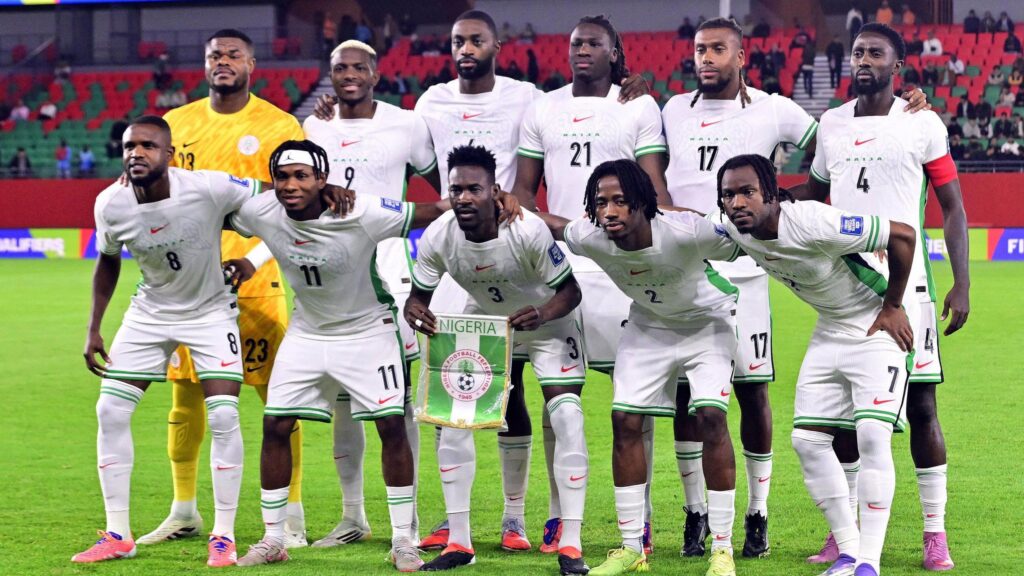
“Back to the drawing board” for Nigeria after World Cup qualifying failure
Nigeria’s hopes for the 2026 World Cup, which is set to take place in the United States, Mexico, and Canada, have been dashed after a lackluster qualifying campaign that saw them unable to secure a spot in the tournament.
Nigeria’s Disappointment in World Cup Qualifying
Fans of the three-time African champions are grappling with the realization that their team will miss out on the World Cup for the second consecutive time. This disappointing outcome followed a troubled qualification effort characterized by two managerial changes and player training boycotts.
Despite fielding talented players such as Victor Osimhen, Ademola Lookman, and Alex Iwobi, Nigeria could not secure one of the 48 available slots for the finals after suffering a penalty shootout defeat to DR Congo in the African playoff final.
The fabric of Nigeria’s footballing history is rich — they made their debut in the 1994 World Cup in the United States, reaching the Round of 16, and they clinched gold in the 1996 Olympics. Unfortunately, the current fifth-ranked team in Africa will not extend that legacy in the upcoming tournament.
Voodoo Accusations Following Penalty Loss
The Super Eagles had a promising beginning against DR Congo, taking the lead early through Frank Onyeka’s goal, but they could not maintain their momentum as Meschack Elia equalized shortly after.
After losing their key player Osimhen to injury before halftime, Nigeria struggled to create scoring opportunities. During the penalty shootout, mistakes were made, with Calvin Bassey missing the target and Moses Simon’s attempt being saved.
Coach Eric Chelle raised eyebrows with allegations directed at a member of the DR Congo technical staff, claiming “voodoo” influenced the penalty outcome. While such allegations are not unheard of in African football, they are considered rare today, leading some reporters to find Chelle’s assertions to be quite extraordinary.
Behind-the-Scenes Challenges
Off-field issues complicated Nigeria’s focus as they prepared for crucial matches. Soon after arriving in Morocco, both players and coaching staff boycotted training over disputes regarding unpaid allowances and match bonuses just two days before their semifinal against Gabon.
Fans viewed this incident as indicative of larger governance issues within the Nigeria Football Federation (NFF), expressing frustration over administrative shortcomings and poor leadership. The issue was addressed the next day, with defender William Troost-Ekong asserting their commitment to unite for the nation.
Afterwards, they managed to convincingly defeat Gabon 4-1 after extra time, but they could not replicate that performance in the final against DR Congo.
The Road to the Playoffs
In summary, Nigeria’s journey through the two-year qualification process was marked by subpar performance. Coaching changes and Osimhen’s absence severely impacted their chances, as the team secured only four points from 15 available in matches without him.
Nigeria was placed in Group C alongside South Africa, Benin, Zimbabwe, Rwanda, and Lesotho, managing to reach the playoffs despite being considered the top seeds. They struggled, settling for draws against Lesotho and Zimbabwe, leading to the departure of coach Jose Peseiro after his contract ended in March 2024.
Finidi George took over, but his short stint featured a damaging draw against South Africa and a defeat in Benin, leaving the Super Eagles in a precarious position.
Immediate Reaction
Since the exit from qualification, many Nigerian fans have expressed their discontent online, criticizing both the team’s performances and the shortcomings of the NFF. Concerns have been raised about the lack of investment in local football infrastructure, given that many players are trained in foreign academies.
Journalist David Hundeyin remarked that the way Nigerian football is managed is reflective of broader governance issues in the country, noting that the paradox of achieving success with insufficient effort has fostered unrealistic expectations.
Meanwhile, rival African nations, especially Ghana, which also qualified for the 2026 World Cup, have reveled in Nigeria’s misery after ousting them in the previous qualifying round for the Qatar 2022 World Cup.
What’s Next for Nigeria?
Looking ahead, the Super Eagles will need to quickly shift their focus as they prepare for the 2025 Africa Cup of Nations on December 23 against Tanzania, with just 36 days remaining before kickoff.
This is a wake-up call,
remarked Abiodun Ogunjimi from the Nigeria Football Supporters Club.
We need to revisit our strategy and address our issues.
The NFF is likely to review Chelle’s position as delivering a World Cup qualifying berth was a key goal outlined in his contract. The first non-Nigerian African to lead the Super Eagles, Chelle has begun to foster a more cohesive team identity, but whether a change in leadership would be beneficial in the short term remains uncertain.
Moving forward, the NFF must outline a comprehensive plan for Nigeria’s resurgence toward World Cup participation in 2030.