Erling Haaland: Is the Manchester City Forward Overexerting Himself on the Pitch?
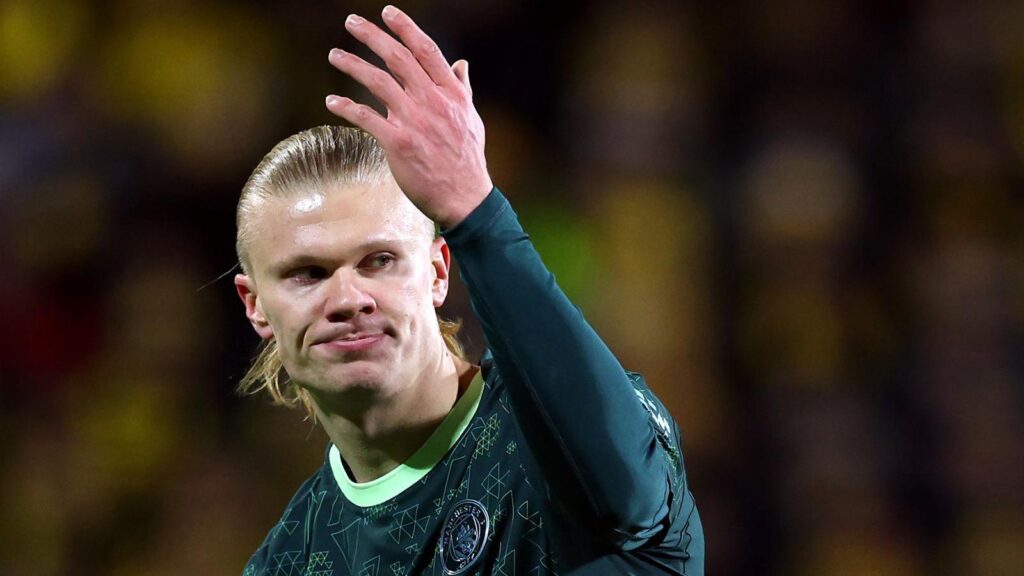
“An Overload of Matches?” – Is Haaland Overexerted This Season?
A Striker in Decline
Erling Haaland began the season with an explosive performance, demonstrating his remarkable capabilities. However, his recent form has dipped significantly.
Despite netting an impressive total of 39 goals across all competitions for both club and country this season, the Manchester City forward has experienced a slump, finding the back of the net only once in his last eight matches.
This slump coincides with Manchester City’s struggles in the Premier League title race and a shocking defeat in the Champions League against Bodo/Glimt. Pep Guardiola attributed the team’s lackluster performance during last week’s derby against Manchester United to a dip in energy levels, sparking questions: Has Haaland played too many matches, and should Guardiola have rested him?
Haaland Acknowledges His Shortcomings
Haaland’s recent dwindling performance was encapsulated during a chilly trip to the Arctic Circle, where Manchester City found themselves unexpectedly down by two goals. A pivotal chance came his way just before halftime, but he missed a clear shot from eight yards out—an effort that would have typically sent the ball into the net earlier this season.
Currently, he remains without a goal from open play in eight consecutive games—his longest such streak at both Borussia Dortmund and Manchester City, with only one penalty conversion during this period.
“I don’t have the answers,” Haaland expressed to TNT Sports post-match. “I take full responsibility for not scoring when I should have, and I apologize to every single Manchester City supporter who traveled to support us.” He noted his continuous efforts to contribute, even as he grapples with fatigue from what he described as an excessive schedule.
So far this season, Haaland has played in 31 matches, racking up 2,568 minutes—a figure placing him 12th among all Premier League players regarding minutes played. However, he ranks second among forwards in Europe’s top leagues, with only Crystal Palace’s Jean-Philippe Mateta surpassing him in matches played.
As the season unfolds with 16 league games left, not to mention potential appearances in the Carabao Cup, FA Cup, Champions League, and two international friendlies, he could face an additional 33 matches—bringing his total to 69 before the summer’s World Cup.
A Possible Solution to Haaland’s Form
Haaland’s goal drought has not only seen a dip in goals but also in many other pivotal attacking metrics. Since his last goal from open play against West Ham, he has recorded fewer shots per game, alongside a notable decrease in touches in the opposition box and expected goals (xG) metrics.
In addition, injuries to key defenders like Ruben Dias and Josko Gvardiol have hindered the team’s ability to push the ball forward quickly, while Rodri is also seeking to regain his best form. Phil Foden has been unable to contribute with goals or assists since that same West Ham match.
While Haaland has accepted accountability for his recent performance, Guardiola must also assess his decision to grant the striker so much playing time this season. For instance, fielding Haaland for 45 minutes during a low-stakes FA Cup match against Exeter City seemed questionable when an opportunity existed for a young player to shine.
The manager’s previous experience—like the unforeseen 2-0 home loss to Bayer Leverkusen when he altered the starting lineup significantly—could also weigh heavily on his mind.
Nonetheless, as more options become available, including the return of Omar Marmoush and the recent acquisition of Antoine Semenyo, the pressure on Haaland to score could lessen.
Despite another disappointing performance, former Premier League player Chris Sutton stated that he is not worried about Haaland’s abilities. “He has consistently found the back of the net, and I believe he will bounce back,” Sutton commented. “Anyone doubting his talents is making a significant mistake.”
Tactical Investigations: Do City Play to Haaland’s Strengths?
It may seem peculiar to question Haaland’s integration into the team, considering he is the league’s leading scorer with 20 goals. Yet, over the past eight games, he has not converted a single goal from open play.
Guardiola has commented on the congested fixture list, but are there tactical adaptations contributing to Haaland’s drop in form?
Historically, Haaland has thrived in situations where he can run behind defenses. His optimal scoring opportunity involves a through ball that allows him to make a diagonal run, setting him up to shoot effectively from the left side.
Initially, City leveraged a direct and transitional style of play, exploiting the speed of players like Jeremy Doku and Haaland, resulting in more rapid goal-scoring breaks than seen in recent seasons. This approach has greatly benefited Haaland.
However, with the emphasis on a quick attack, the risk of conceding counterattacks also rises. Guardiola has hinted at a desire to transition back to a more measured style in line with previous successful squads.
As the season has progressed, City has been adopting a more controlled approach, which ideally minimizes counterattacks while also facing more defensive blocks. Unfortunately, injuries to key players have hindered their ability to execute this strategy effectively.
So, what are the implications for Haaland? The absence of ball-playing defenders limits the team’s capability to advance into threatening positions quickly, diminishing pass opportunities for Haaland to utilize.
The team’s recent tactical choices have resulted in a scenario where Haaland must adapt to receiving fewer passes from deep positions. If the squad can successfully push opposing teams back, Haaland tends to respond positively with several tactical approaches—be it making clever runs in the box or timing his movements for optimal positioning.
If Manchester City can create more space for him through dynamic movements or speedy transitions, it may aid in revitalizing Haaland’s scoring touch.
Ultimately, with the right strategic adjustments, including finding opportunities to capitalize on his height through crosses, Haaland’s contributions could be re-established, allowing him to regain his formidable scoring form.