‘It’s a dream’ – African Champions set to face Arsenal
Image source, Getty Images
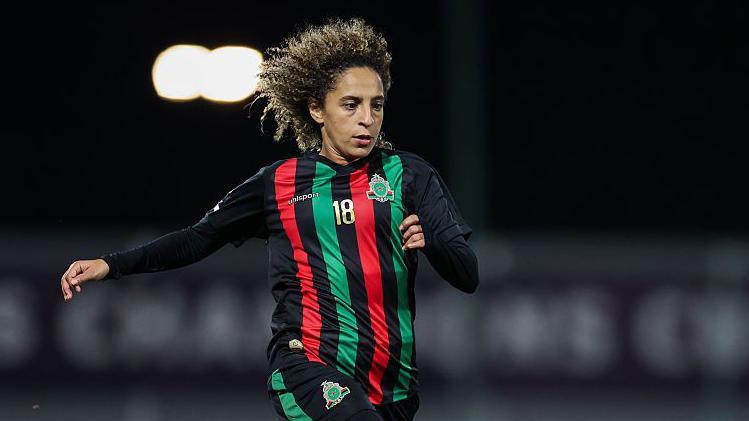
Moroccan forward Sanaa Mssoudy was honored as the African interclub player of the year for 2025.
On Wednesday night, enthusiastic supporters will flock to cafes in Morocco’s capital, Rabat, to support their team against Arsenal.
However, they won’t be witnessing Mikel Arteta’s squad at Emirates Stadium.
Instead, they will watch the women’s team led by Renee Slegers face AS FAR at Brentford’s Gtech Community Stadium (18:00 GMT).
Earlier, Brazilian Corinthians squared off against Gotham FC from New York in the other semi-final of the inaugural Women’s Champions Cup (12:30).
The champions will meet at Arsenal’s Emirates Stadium on Sunday, 1 February (18:00) with a prize of $2.3 million (£1.7 million)—the largest single sum in women’s club football—awaiting the winners.
But who exactly is AS FAR—and how have they risen to become the queens of African football?
A military club established by the monarch
The Association Sportive des Forces Armees Royales (AS FAR) was established in 1958 by the late King Moulay El Hassan II, making it the military club of Morocco.
This link has enabled their women’s team to emerge as leaders in Africa.
Having faced fewer financial pressures than private clubs, AS FAR, which launched women’s football in 2001 as the nation’s first professional club, has made significant investments in its women’s program over the last decade.
They have been a dominant force nationally, capturing virtually every league title since 2013.
Known as The Soldiers, AS FAR has also claimed two continental championships since the inception of the African Women’s Champions League in 2021, with the latest title won in November, securing their position in this inaugural FIFA Champions Cup.
After receiving a bye in the first round, AS FAR overcame a deficit to defeat Chinese team Wuhan Jiangda in extra time, earning the opportunity to compete against Arsenal.
While they face a considerable challenge in this upcoming semi-final, they should not be underestimated. The squad features several Moroccan internationals, with seven players having been part of the Atlas Lionesses team that reached the knockout stage of the 2023 World Cup.
Annisa Lahmari, a graduate of Paris St-Germain’s academy, scored the decisive goal that propelled Morocco past Germany into the last 16 of the World Cup before transferring to AS FAR last year.
Arsenal needs to be cautious of skilled wingers Sanaa Mssoudy and Fatima Tagnaout, who are both regulars for Morocco.
This matchup marks the first occasion an African team will compete against a European side in a formal match.
“AS FAR’s match against Arsenal is a historic moment,” remarked former captain and current Morocco national team star Ghizlane Chebbak to BBC Sport.
“This event reflects the progress the club has achieved and marks significant advancements in women’s football in Morocco.”
Morocco spearheads the revolution in women’s football across Africa
Remarkable is indeed the word.
In the last ten years, Morocco has transitioned from a minor player in women’s football to one of Africa’s leading nations. This transition has been supported by significant investments from both the Royal Moroccan Football Federation (FRMF) and the Moroccan government.
In 2020, the government allocated funds for every team in the top two divisions of women’s football, covering wages for players, coaches, and medical staff. This shift transformed those divisions from essentially amateur to professional overnight.
Each of the 14 teams in the top division is equipped with 13 full-time players receiving $500 (£369) a month from the Federation. An additional seven players receive $350 (£259), while head coaches are compensated $500. Although modest, this financial support establishes a baseline, akin to a universal basic income.
Clubs supplement these payments, with elite players in the league earning upwards of $2,000 (£1,475) per month.
“I’m just regretful I wasn’t able to experience this as a player,” reflects Khadija Illa, a former player and current president of the Moroccan league. “Yet, seeing the girls live this dream makes me feel as if I’m part of it.”
“Two decades ago, you might have asked, ‘Is anyone playing in Morocco?’ Now, we’re the champions of Africa preparing to face Arsenal.”
The King Mohammed VI Training Complex, spanning 2.5 square kilometers, was inaugurated in 2009.
This investment extends beyond clubs. The national team trains at the King Mohammed VI Training Complex, which also caters to the men’s team and various youth squads.
The $65 million facility includes eight full-sized pitches, futsal and beach courts, a gym, medical provisions, an Olympic-sized swimming pool, classrooms, and a luxurious hotel.
Rosella Ayane, a Leicester City forward who transitioned from England youth teams to Morocco, once described the complex as “St George’s Park with palm trees”.
After failing to qualify for the Women’s Africa Cup of Nations (Wafcon) since 2000, Morocco successfully hosted consecutive tournaments in 2022 and 2025, reaching the finals each time, and will also host the 2026 edition.
They also made their World Cup debut in 2023, where they lost to France 4-0 in the last 16.
Jorge Vilda, a former Spain manager, took the reins of the Moroccan women’s team in 2023.
Morocco is not alone in experiencing immense progress over recent years, as women’s football across Africa is beginning to professionalize.
Both South Africa and Nigeria also advanced to the knockout stage of the World Cup, with Nigeria only being edged out by England on penalties in the last 16.
Next destination, world champions?
In 2025, AS FAR clinched their second CAF Champions League title, securing their spot in the FIFA Champions Cup.
The launch of the African Women’s Champions League in 2021 has elevated club football standards across the continent. Designed as a unique tournament that features eight teams selected regionally, it showcases Africa’s best teams against one another.
AS FAR and South Africa’s Mamelodi Sundowns are two-time winners of the tournament, with TP Mazembe from the Congo securing the only other edition.
In last year’s event, held in November, AS FAR triumphed over Ivorian team ASEC Mimosas in the final, which secured their entry into this Champions Cup and set up their encounter with Arsenal.
“This really feels like a dream,” concludes Illa.
“I could never have imagined that girls in Morocco would compete against Arsenal or play in London—but now it’s a reality.”