Growing Concerns Over Safety for European Football Away Fans
A Dream Turned Dangerous
Football enthusiasts across the nation often fantasize about traveling with their clubs to European matches, sharing thrilling moments with friends and family. However, the reality of traveling abroad for these games has become increasingly perilous. The past few years have seen alarming incidents where fan safety has been severely compromised.
The fallout from the 2022 Champions League final highlighted significant security failures attributed to UEFA and local French authorities, leading to an event described as nearly catastrophic. In subsequent years, supporters from prominent clubs like Manchester City, Manchester United, and Newcastle have voiced serious concerns regarding security protocols at matches in various European cities, including Istanbul, Lyon, and Marseille.
Recently, fans were prohibited from attending some Champions League matches amid rising security problems, which some argue have only worsened, robbing fans of their dignity and at times creating perilous situations.
Reported Issues by Fans
Fans have consistently reported several pressing issues, including:
- Aggressive policing tactics
- Crowd crushes due to ineffective management of stadium entry and exit procedures
- Inadequate access to restroom facilities
- Intrusive body searches
- Confiscation of essential items, such as power banks and medications
Are conditions at these high-profile matches deteriorating?
‘Lives Are Being Placed At Risk’
“There are nations where the situation is indeed declining, such as Germany, Belgium, and the Netherlands,” stated Ronan Evain, the executive director of Football Supporters Europe (FSE). The FSE encourages fans to complete surveys about their experiences after attending European fixtures.
Evain continued, “There are repeat offenders – nations and clubs that consistently fail to create a safe environment for hosting matches.” He pointed out that despite hosting many international visitors, countries like France, Spain, Portugal, and Italy often treat football fans unfairly, viewing them as threats.
European match security frameworks involve collaborations between host clubs, national governments, local authorities, and regional police forces, with contributions from UEFA. Treatment of fans varies widely depending on multiple factors including the locality, the behavior of home supporters, and the context of the fixture.
Evain added, “Small humiliations, like being forced to enter a stadium four hours early or having innocuous items confiscated, are often either unnecessary or a means for police control.”
Experiences of Fans on Away Trips
Fans who frequently travel for European matches shared their experiences during the latest UEFA competitions, highlighting a range of interactions with security ranging from positive to troubling:
Gemma Manns, Chelsea Fan in Naples, Italy:
“We chose to arrive in Naples the afternoon of the match due to the local fans’ notorious reputation for hostility. Although we experienced efficient security checks at the stadium, the post-match situation was worrying. We were held for over an hour after the game while local ultras made intimidating gestures, and upon heading towards the buses, police presence vanished, leaving us vulnerable.”
Jude Aston, Aston Villa Fan in Istanbul, Turkey:
“As a wheelchair user, the expectations set by Villa didn’t prepare me for the reality. We were confined in a cage at the stadium, which hindered my view of the match and confined my movements severely, making me feel unsafe during an emergency.”
Jane Boland, Liverpool Fan in Marseille, France:
“The riot police made entering and exiting the stadium a daunting task. Overcrowded waits and insufficient toilet access added to my discomfort, and it took over two hours to leave the stadium after the match.”
Sue Fox, Spurs Fan in Frankfurt, Germany:
“Transportation was organized, but when we got to the stadium, we faced long queues in cramped conditions. The lack of accessible facilities for women was unsettling.”
These experiences expose a troubling trend facing supporters as they travel to follow their teams.
Is It Dignity at Stake?
Multiple negatives reported by fans, including insufficient facilities for disabled patrons and restricted toilet access, run counter to UEFA’s established guidelines. The difficulties faced by disabled fans are especially alarming.
Owain Davies, CEO of Level Playing Field, emphasized, “It’s frustrating to witness wheelchair users confined in cages during matches, reflecting a systemic issue of inequality within tournaments sanctioned by UEFA.”
Davies added, “Despite UEFA’s commitment to accessibility published over a year ago, there has been little action to enforce necessary changes.”
Travel Bans as a Growing Trend
The growing practice of regional police barring away fans from matches has become all too frequent, particularly in places like France, Italy, and the Netherlands. Last year, supporters of Maccabi Tel-Aviv faced a travel ban for their match against Aston Villa, which is unusual within the UK context.
In many instances, traveling fans have faced restrictions not only from attending matches but also from entering the host city’s center. Evain remarked, “Such bans signal a failure of the authorities to ensure a safe match environment.”
UEFA’s Response
In response to inquiries from BBC Sport concerning the issues expressed by supporters, UEFA stated that they have enhanced alliances with key European stakeholders regarding safety and security. They also reported a measurable decline in incidents at matches, suggesting a potential improvement.
On the topic of access for disabled supporters, UEFA expressed a strong commitment to making match experiences inclusive and safe. Emphasizing that progress requires cooperation among all stakeholders, they acknowledged challenges that still need addressing.
Concerns Over Lack of Reforms
Despite UEFA’s statements of improved safety measures, many fans reported that organizational issues and authority mismanagement pose greater risks than rival supporters.
Experts point to a challenging political landscape in Europe that impacts police accountability, making football fans an easy target for enforcement strategies.
The findings from the investigation into the controversial 2022 incident primarily blamed UEFA, calling for better security protocols at matches. Professor Clifford Stott, one of the report’s authors, highlighted a lack of substantive reform in response to their recommendations, expressing concern that safety at future events remains endangered.
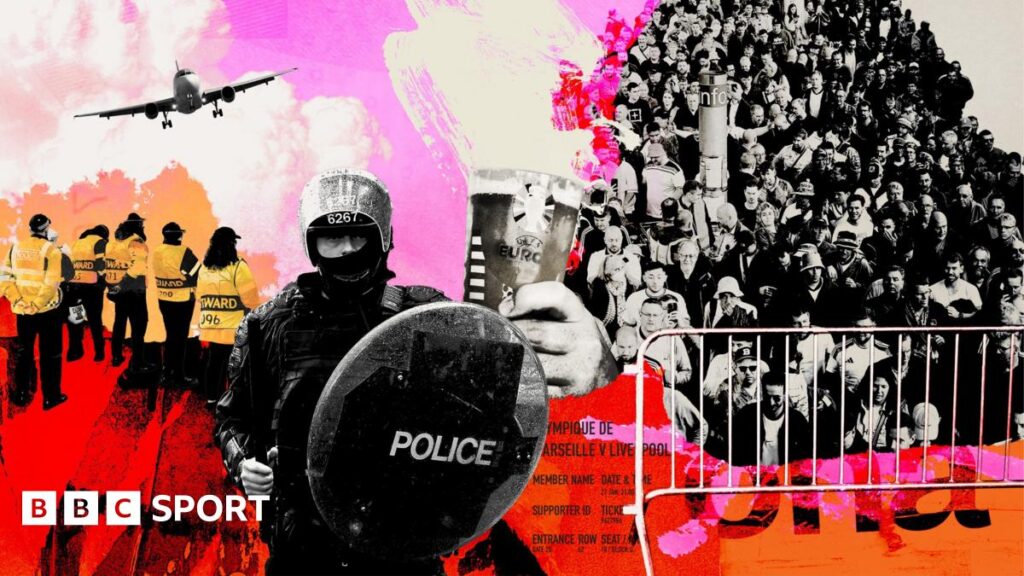
Illustration by Eleanor Shakespeare