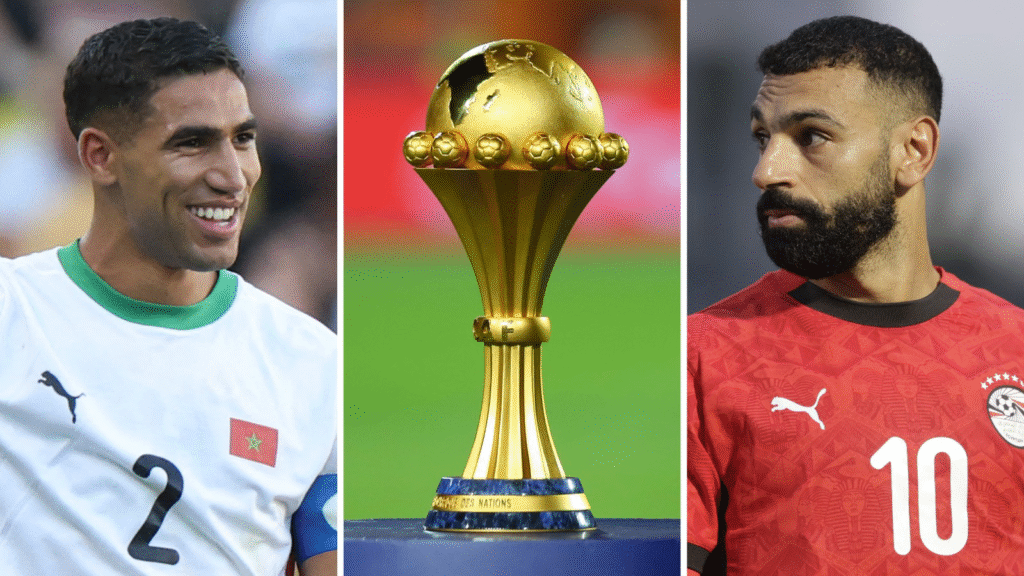
Can Salah finally win the Afcon trophy while Morocco aims for success at home?
Image source, Getty Images
Achraf Hakimi and Mohamed Salah are set to lead their nations in pursuit of success at the Africa Cup of Nations.
With a heated discussion surrounding player readiness and the tournament’s timing, attention has turned toward the imminent start of the Africa Cup of Nations (Afcon) in Morocco this Sunday.
Key questions leading into the 2025 finals revolve around whether Morocco can continue their remarkable streak of 18 consecutive victories to claim only their second title, and if Mohamed Salah will finally secure the trophy with Egypt.
Salah’s future at Liverpool has taken center stage following his provocative comments on December 6 about feeling “thrown under the bus”
Now, following a brief stint from the substitutes’ bench at Anfield, Salah is focused on making the most of his fifth chance to capture Africa’s most prestigious prize after previously losing two finals.
However, focusing solely on these two narratives would overlook the essence of a tournament renowned for its unpredictability.
For instance, Ivory Coast remarkably triumphed at home last February despite dismissing their coach during the group stage, while Senegal emphasized their strength with a victory against England in June.
Meanwhile, Nigeria is hoping to improve on their 2023 finals performance, while Cameroon appears to be in disarray, with both teams keen to redeem themselves after missing the 2026 FIFA World Cup.
With seven different champions crowned in the last eight tournaments, Afcon 2025 promises to be an exciting spectacle as teams vie for the trophy dubbed the “holy grail of African football” by Benin’s assistant coach, Tunde Adelakun.
“Winning the Africa Cup of Nations is incredibly challenging. The public will remember you forever if you succeed,” commented Moroccan midfielder Sofyan Amrabat on the BBC World Service.
Morocco anticipates
Image source, Getty Images
Walid Regragui has guided Morocco to the semi-finals of the Qatar 2022 World Cup, making history by being the first African team to reach the final four.
As the favorites with home-ground advantage, the Atlas Lions are expected to convert their successful run in the lead-up to the event into a strong performance.
While their impressive streak of victories has outshone Spain’s previous record of 15, it’s important to note that their only top 50 opponent defeated was Tunisia (ranked 49) in June.
Coach Walid Regragui and his players, who were eliminated in the round of 16 during the last competition, must manage the mounting expectations.
Home tickets quickly sold out, and fans are eager to fill the stands in Rabat on January 18 to witness the country’s first Afcon title since 1976.
Achraf Hakimi’s fitness is a concern, yet if he is unable to play, Morocco is still poised to advance beyond the group stage.
“We need to generate an atmosphere like we had in Qatar with the whole nation behind us,” stated Amrabat, a former Manchester United player.
“In Africa, it’s crucial to play with passion. The fans’ energy is vital for us. If we can channel that intensity along with our skills, we can go far in the tournament.”
Earlier this year, protests surfaced from Gen Z regarding investments in football infrastructure ahead of Morocco’s joint hosting of the 2030 World Cup, while tragic flash floods in Safi recently claimed 37 lives.
Event organizers are mindful of potential disruptions during Afcon as Morocco aims to secure its status as Africa’s foremost footballing nation.
Concerns in the lead-up
The mid-season timing of Afcon has sparked challenges for European clubs, but the Confederation of African Football (Caf) had limited options after FIFA scheduled an expanded Club World Cup for June and July.
With calendar clashes owing to additional Champions League dates, FIFA intervened, mandating that players only needed to be released seven days before the finals instead of the customary 14 days before major competitions.
This shift disrupted the preparations of several countries, with Mali’s coach Tom Saintfiet deeming the change a “disaster.”
“The world must respect African football,” the Belgian stated.
Mali’s group stage rivals Comoros, whose squad is entirely comprised of overseas-based players, consequently had to scale back their training camp and forgo a friendly match, jeopardizing their readiness for their opening game against Morocco.
“It’s frustrating to learn about this change just a week prior; it wasn’t fair,” remarked Coelacanths coach Stefano Cusin.
“Had we known earlier, we could have adjusted our plans.”
Caf remains steadfast in conducting the tournament biannually, relying on its primary income source to reinvest in African football.
Turmoil for Cameroon
Image source, EPA
Marc Brys was dismissed as the head coach of Cameroon on December 1, following allegations of “professional misconduct” and “underhand tactics.”
Looking at other potential contenders, South Africa has developed a solid group under Hugo Broos, who previously led Cameroon to victory in 2017.
Algeria features the leading scorer from the African World Cup qualifiers, Mohamed Amoura, who netted 10 goals, steering the North African side toward their first knockout stage in three editions.
Conversely, Cameroon, having won five titles, faces significant turmoil, as federation president Samuel Eto’o has removed coach Marc Brys, and key players Andre Onana and Vincent Aboubakar were omitted from the team.
“Our goal was to adopt a different approach. While they are talented players, we are focusing on others to cultivate a fresh mentality,” explained new head coach David Pagou.
No new players are debuting, although Sudan astonishingly qualified despite playing all qualifiers away due to the ongoing civil unrest.
Botswana, Mozambique, and Tanzania are on quests for their first ever Afcon victories and hope to progress beyond the group phase, with Tanzania also preparing to co-host the next tournament in 2027 along with Kenya and Uganda.
With 12 former champions participating, the chances of a first-time winner appear slim, yet seasoned observers know that surprises are a staple of the Cup of Nations.